



“And when they were come to the place,
which is called Calvary, there they crucified Him.”
“That He might sanctify the people with His
own blood,” Christ “suffered without the gate.” Heb. 13:12. For
transgression of the law of God, Adam and Eve were banished from Eden. Christ,
our substitute, was to suffer without the boundaries of Jerusalem. He died
outside the gate, where felons and murderers were executed. Full of
significance are the words, “Christ hath redeemed us from the curse of the
law, being made a curse for us.” Gal. 3:13.
A vast multitude followed Jesus from the
judgment hall to Calvary. The news of His condemnation had spread throughout
Jerusalem, and people of all classes and all ranks flocked toward the place of
crucifixion. The priests and rulers had been bound by a promise not to molest
Christ’s followers if He Himself were delivered to them, and the disciples and
believers from the city and the surrounding region joined the throng that
followed the Saviour.
As Jesus passed the gate of Pilate’s court, the cross which had been
prepared for Barabbas was laid upon His bruised and bleeding shoulders. Two
companions of Barabbas were to suffer death at the same time with Jesus, and
upon them also crosses were placed. The Saviour’s burden was too heavy for Him
in His weak and suffering condition. Since the Passover supper with His
disciples, He had taken neither food nor drink. He had agonized in the garden
of Gethsemane in conflict with satanic agencies. He had endured the anguish of
the betrayal, and had seen His disciples forsake Him and flee. He had been
taken to Annas, then to Caiaphas, and then to Pilate. From Pilate He had been
sent to Herod, then sent again to Pilate. From insult to renewed insult, from
mockery to mockery, twice tortured by the scourge, – all that night there had
been scene after scene of a character to try the soul of man to the uttermost.
Christ had not failed. He had spoken no word but that tended to glorify God.
All through the disgraceful farce of a trial He had borne Himself with firmness
and dignity. But when after the second scourging the cross was laid upon Him,
human nature could bear no more. He fell fainting beneath the burden.
The crowd that followed the Saviour saw His weak and staggering steps, but they manifested no compassion. They taunted and reviled Him because He could not carry the heavy cross. Again the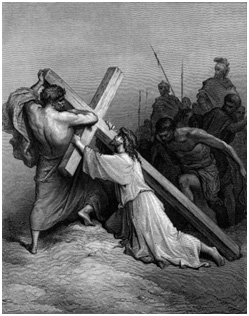
burden was laid upon Him, and again He fell fainting to the ground. His persecutors saw that it was impossible for Him to carry His burden farther. They were puzzled to find anyone who would bear the humiliating load. The Jews themselves could not do this, because the defilement would prevent them from keeping the Passover. None even of the mob that followed Him would stoop to bear the cross.
At this time a stranger, Simon a Cyrenian,
coming in from the country, meets the throng. He hears the taunts and ribaldry
of the crowd; he hears the words contemptuously repeated, Make way for the King
of the Jews! He stops in astonishment at the scene; and as he expresses his
compassion, they seize him and place the cross upon his shoulders.
Simon had heard of Jesus. His sons were
believers in the Saviour, but he himself was not a disciple. The bearing of the
cross to Calvary was a blessing to Simon, and he was ever after grateful for
this providence. It led him to take upon himself the cross of Christ from
choice, and ever cheerfully stand beneath its burden.
Not a few women are in the crowd that follow the
Uncondemned to His cruel death. Their attention is fixed upon Jesus. Some of
them have seen Him before. Some have carried to Him their sick and suffering
ones. Some have themselves been healed. The story of the scenes that have taken
place is related. They wonder at the hatred of the crowd toward Him for whom
their own hearts are melting and ready to break. And notwithstanding the action
of the maddened throng, and the angry words of the priests and rulers, these
women give expression to their sympathy. As Jesus falls fainting beneath the
cross, they break forth into mournful wailing.
This was the only thing that attracted Christ’s
attention. Although full of suffering, while bearing the sins of the world, He
was not indifferent to the expression of grief. He looked upon these women with
tender compassion. They were not believers in Him; He knew that they were not
lamenting Him as one sent from God, but were moved by feelings of human pity.
He did not despise their sympathy, but it awakened in His heart a deeper
sympathy for them. “Daughters of Jerusalem,” He said, “weep not
for Me, but weep for yourselves, and for your children.” From the scene
before Him, Christ looked forward to the time of Jerusalem’s destruction. In
that terrible scene, many of those who were now weeping for Him were to perish
with their children.
From the fall of Jerusalem the thoughts of Jesus
passed to a wider judgment. In the destruction of the impenitent city He saw a
symbol of the final destruction to come upon the world. He said, “Then
shall they begin to say to the mountains, Fall on us; and to the hills, Cover
us. For if they do these things in a green tree, what shall be done in the
dry?” By the green tree, Jesus represented Himself, the innocent Redeemer.
God suffered His wrath against transgression to fall on His beloved Son. Jesus
was to be crucified for the sins of men. What suffering, then, would the sinner
bear who continued in sin? All the impenitent and unbelieving would know a
sorrow and misery that language would fail to express.
Of the multitude that followed the Saviour to
Calvary, many had attended Him with joyful hosannas and the waving of palm
branches as He rode triumphantly into Jerusalem. But not a few who had then
shouted His praise, because it was popular to do so, now swelled the cry of
“Crucify Him, crucify Him.” When Christ rode into Jerusalem, the
hopes of the disciples had been raised to the highest pitch. They had pressed
close about their Master, feeling that it was a high honor to be connected with
Him. Now in His humiliation they followed Him at a distance. They were filled
with grief, and bowed down with disappointed hopes. How were the words of Jesus
verified: “All ye shall be offended because of Me this night: for it is
written, I will smite the shepherd, and the sheep of the flock shall be
scattered abroad.” Matt. 26:31.
Arriving at the place of execution, the
prisoners were bound to the instruments of torture. The two thieves wrestled in
the hands of those who placed them on the cross; but Jesus made no resistance.
The mother of Jesus, supported by John the beloved disciple, had followed the
steps of her Son to Calvary. She had seen Him fainting under the burden of the
cross, and had longed to place a supporting hand beneath His wounded head, and
to bathe that brow which had once been pillowed upon her bosom. But she was not
permitted this mournful privilege. With the disciples she still cherished the
hope that Jesus would manifest His power, and deliver Himself from His enemies.
Again her heart would sink as she recalled the words in which He had foretold
the very scenes that were then taking place. As the thieves were bound to the
cross, she looked on with agonizing suspense. Would He who had given life to
the dead suffer Himself to be crucified? Would the Son of God suffer Himself to
be thus cruelly slain? Must she give up her faith that Jesus was the Messiah?
Must she witness His shame and sorrow, without even the privilege of
ministering to Him in His distress? She saw His hands stretched upon the cross;
the hammer and the nails were brought, and as the spikes were driven through
the tender flesh, the heart-stricken disciples bore away from the cruel scene
the fainting form of the mother of Jesus.
The Saviour made no murmur of complaint. His
face remained calm and serene, but great drops of sweat stood upon His brow.
There was no pitying hand to wipe the death dew from His face, nor words of
sympathy and unchanging fidelity to stay His human heart. While the soldiers
were doing their fearful work, Jesus prayed for His enemies, “Father,
forgive them; for they know not what they do.” His mind passed from His
own suffering to the sin of His persecutors, and the terrible retribution that
would be theirs. No curses were called down upon the soldiers who were handling
Him so roughly. No vengeance was invoked upon the priests and rulers, who were
gloating over the accomplishment of their purpose. Christ pitied them in their
ignorance and guilt. He breathed only a plea for their forgiveness,–“for
they know not what they do.”
Had they known that they were putting to torture
One who had come to save the sinful race from eternal ruin, they would have
been seized with remorse and horror. But their ignorance did not remove their
guilt; for it was their privilege to know and accept Jesus as their Saviour.
Some of them would yet see their sin, and repent, and be converted. Some by
their impenitence would make it an impossibility for the prayer of Christ to be
answered for them. Yet, just the same, God’s purpose was reaching its
fulfillment. Jesus was earning the right to become the advocate of men in the
Father’s presence.
That prayer of Christ for His enemies embraced
the world. It took in every sinner that had lived or should live, from the
beginning of the world to the end of time. Upon all rests the guilt of
crucifying the Son of God. To all, forgiveness is freely offered.
“Whosoever will” may have peace with God, and inherit eternal life.
As soon as Jesus was nailed to the cross, it was
lifted by strong men, and with great violence thrust into the place prepared
for it. This caused the most intense agony to the Son of God. Pilate then wrote
an inscription in Hebrew, Greek, and Latin, and placed it upon the cross, above
the head of Jesus. It read, “Jesus of Nazareth the King of the Jews.”
This inscription irritated the Jews. In Pilate’s court they had cried,
“Crucify Him.” “We have no king but Caesar.” John 19:15.
They had declared that whoever should acknowledge any other king was a traitor.
Pilate wrote out the sentiment they had expressed. No offense was mentioned,
except that Jesus was the King of the Jews. The inscription was a virtual
acknowledgment of the allegiance of the Jews to the Roman power. It declared that
whoever might claim to be the King of Israel would be judged by them worthy of
death. The priests had overreached themselves. When they were plotting the
death of Christ, Caiaphas had declared it expedient that one man should die to
save the nation. Now their hypocrisy was revealed. In order to destroy Christ,
they had been ready to sacrifice even their national existence.
The priests saw what they had done, and asked
Pilate to change the inscription. They said, “Write not, The King of the
Jews; but that He said, I am King of the Jews.” But Pilate was angry with
himself because of his former weakness, and he thoroughly despised the jealous
and artful priests and rulers. He replied coldly, “What I have written I
have written.”
A higher power than Pilate or the Jews had
directed the placing of that inscription above the head of Jesus. In the
providence of God it was to awaken thought, and investigation of the
Scriptures. The place where Christ was crucified was near to the city.
Thousands of people from all lands were then at Jerusalem, and the inscription
declaring Jesus of Nazareth the Messiah would come to their notice. It was a
living truth, transcribed by a hand that God had guided.
In the sufferings of Christ upon the cross
prophecy was fulfilled. Centuries before the crucifixion, the Saviour had
foretold the treatment He was to receive. He said, “Dogs have compassed
Me: the assembly of the wicked have enclosed Me: they pierced My hands and My
feet. I may tell all My bones: they look and stare upon Me. They part My
garments among them, and cast lots upon My vesture.” Ps. 22:16-18. The
prophecy concerning His garments was carried out without counsel or
interference from the friends or the enemies of the Crucified One. To the
soldiers who had placed Him upon the cross, His clothing was given. Christ
heard the men’s contention as they parted the garments among them. His tunic
was woven throughout without seam, and they said, “Let us not rend it, but
cast lots for it, whose it shall be.”
In another prophecy the Saviour declared,
“Reproach hath broken My heart; and I am full of heaviness: and I looked
for some to take pity, but there was none; and for comforters, but I found
none. They gave Me also gall for My meat; and in My thirst they gave Me vinegar
to drink.” Ps. 69:20, 21. To those who suffered death by the cross, it was
permitted to give a stupefying potion, to deaden the sense of pain. This was
offered to Jesus; but when He had tasted it, He refused it. He would receive
nothing that could becloud His mind. His faith must keep fast hold upon God.
This was His only strength. To becloud His senses would give Satan an
advantage.
The enemies of Jesus vented their rage upon Him
as He hung upon the cross. Priests, rulers, and scribes joined with the mob in
mocking the dying Saviour. At the baptism and at the transfiguration the voice
of God had been heard proclaiming Christ as His Son. Again, just before
Christ’s betrayal, the Father had spoken, witnessing to His divinity. But now
the voice from heaven was silent. No testimony in Christ’s favor was heard.
Alone He suffered abuse and mockery from wicked men.
“If Thou be the Son of God,” they
said, “come down from the cross.” “Let Him save Himself, if He
be Christ, the chosen of God.” In the wilderness of temptation Satan had
declared, “If Thou be the Son of God, command that these stones be made
bread.” “If Thou be the Son of God, cast Thyself down” from the
pinnacle of the temple. Matt. 4:3, 6. And Satan with his angels, in human form,
was present at the cross. The archfiend and his hosts were co-operating with
the priests and rulers. The teachers of the people had stimulated the ignorant
mob to pronounce judgment against One upon whom many of them had never looked,
until urged to bear testimony against Him. Priests, rulers, Pharisees, and the
hardened rabble were confederated together in a satanic frenzy. Religious
rulers united with Satan and his angels. They were doing his bidding.
Jesus, suffering and dying, heard every word as
the priests declared, “He saved others; Himself He cannot save. Let Christ
the King of Israel descend now from the cross, that we may see and
believe.” Christ could have come down from the cross. But it is because He
would not save Himself that the sinner has hope of pardon and favor with God.
In their mockery of the Saviour, the men who
professed to be the expounders of prophecy were repeating the very words which
Inspiration had foretold they would utter upon this occasion. Yet in their
blindness they did not see that they were fulfilling the prophecy. Those who in
derision uttered the words, “He trusted in God; let Him deliver Him now,
if He will have Him: for He said, I am the Son of God,” little thought that
their testimony would sound down the ages. But although spoken in mockery,
these words led men to search the Scriptures as they had never done before.
Wise men heard, searched, pondered, and prayed. There were those who never
rested until, by comparing scripture with scripture, they saw the meaning of
Christ’s mission. Never before was there such a general knowledge of Jesus as
when He hung upon the cross. Into the hearts of many who beheld the crucifixion
scene, and who heard Christ’s words, the light of truth was shining.
To Jesus in His agony on the cross there came
one gleam of comfort. It was the prayer of the penitent thief. Both the men who
were crucified with Jesus had at first railed upon Him; and one under his
suffering only became more desperate and defiant. But not so with his
companion. This man was not a hardened criminal; he had been led astray by evil
associations, but he was less guilty than many of those who stood beside the
cross reviling the Saviour. He had seen and heard Jesus, and had been convicted
by His teaching, but he had been turned away from Him by the priests and
rulers. Seeking to stifle conviction, he had plunged deeper and deeper into
sin, until he was arrested, tried as a criminal, and condemned to die on the
cross. In the judgment hall and on the way to Calvary he had been in company
with Jesus. He had heard Pilate declare, “I find no fault in Him.”
John 19:4. He had marked His godlike bearing, and His pitying forgiveness of
His tormentors. On the cross he sees the many great religionists shoot out the
tongue with scorn, and ridicule the Lord Jesus. He sees the wagging heads. He
hears the upbraiding speeches taken up by his companion in guilt: “If Thou
be Christ, save Thyself and us.” Among the passers-by he hears many defending
Jesus. He hears them repeat His words, and tell of His works. The conviction
comes back to him that this is the Christ. Turning to his fellow criminal he
says, “Dost not thou fear God, seeing thou art in the same
condemnation?” The dying thieves have no longer anything to fear from man.
But upon one of them presses the conviction that there is a God to fear, a
future to cause him to tremble. And now, all sin-polluted as it is, his life
history is about to close. “And we indeed justly,” he moans;
“for we receive the due reward of our deeds: but this Man hath done
nothing amiss.”
There is no question
now. There are no doubts, no reproaches. When condemned for his crime, the
thief had become hopeless and despairing; but strange, tender thoughts now spring
up. He calls to mind all he has heard of Jesus, how He has healed the sick and
pardoned sin. He has heard the words of those who believed in Jesus and
followed Him weeping. He has seen and read the title above the Saviour’s head.
He has heard the passers-by repeat it, some with grieved, quivering lips,
others with jesting and mockery. The Holy Spirit illuminates his mind, and
little by little the chain of evidence is joined together. In Jesus, bruised,
mocked, and hanging upon the cross, he sees the Lamb of God, that taketh away
the sin of the world. Hope is mingled with anguish in his voice as the
helpless, dying soul casts himself upon a dying Saviour. “Lord, remember
me,” he cries, “when Thou comest into Thy kingdom.”
Quickly the answer came. Soft and melodious the tone, full of love, compassion, and power the words: Verily I say unto thee today, Thou shalt be with Me in paradise.
For long hours of agony, reviling and mockery
have fallen upon the ears of Jesus. As He hangs upon the cross, there floats up
to Him still the sound of jeers and curses. With longing heart He has listened
for some expression of faith from His disciples. He has heard only the mournful
words, “We trusted that it had been He which should have redeemed
Israel.” How grateful then to the Saviour was the utterance of faith and
love from the dying thief! While the leading Jews deny Him, and even the
disciples doubt His divinity, the poor thief, upon the brink of eternity, calls
Jesus Lord. Many were ready to call Him Lord when He wrought miracles, and
after He had risen from the grave; but none acknowledged Him as He hung dying
upon the cross save the penitent thief who was saved at the eleventh hour.
The bystanders caught the words as the thief
called Jesus Lord. The tone of the repentant man arrested their attention.
Those who at the foot of the cross had been quarreling over Christ’s garments,
and casting lots upon His vesture, stopped to listen. Their angry tones were
hushed. With bated breath they looked upon Christ, and waited for the response
from those dying lips.
As He spoke the words of promise, the dark cloud
that seemed to enshroud the cross was pierced by a bright and living light. To
the penitent thief came the perfect peace of acceptance with God. Christ in His
humiliation was glorified. He who in all other eyes appeared to be conquered
was a Conqueror. He was acknowledged as the Sin Bearer. Men may exercise power
over His human body. They may pierce the holy temples with the crown of thorns.
They may strip from Him His raiment, and quarrel over its division. But they
cannot rob Him of His power to forgive sins. In dying He bears testimony to His
own divinity and to the glory of the Father. His ear is not heavy that it
cannot hear, neither His arm shortened that it cannot save. It is His royal
right to save unto the uttermost all who come unto God by Him.
I say unto thee today, Thou shalt be with Me in
Paradise. Christ did not promise that the thief should be with Him in Paradise
that day. He Himself did not go that day to Paradise. He slept in the tomb, and
on the morning of the resurrection He said, “I am not yet ascended to My
Father.” John 20:17. But on the day of the crucifixion, the day of
apparent defeat and darkness, the promise was given. “Today” while
dying upon the cross as a malefactor, Christ assures the poor sinner, Thou
shalt be with Me in Paradise.
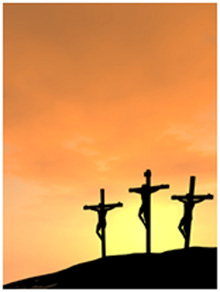
The thieves crucified with Jesus were placed
“on either side one, and Jesus in the midst.” This was done by the
direction of the priests and rulers. Christ’s position between the thieves was
to indicate that He was the greatest criminal of the three. Thus was fulfilled
the scripture, “He was numbered with the transgressors.” Isa. 53:12.
But the full meaning of their act the priests did not see. As Jesus, crucified
with the thieves, was placed “in the midst,” so His cross was placed
in the midst of a world lying in sin. And the words of pardon spoken to the
penitent thief kindled a light that will shine to the earth’s remotest bounds.
With amazement the angels beheld the infinite
love of Jesus, who, suffering the most intense agony of mind and body, thought
only of others, and encouraged the penitent soul to believe. In His humiliation
He as a prophet had addressed the daughters of Jerusalem; as priest and
advocate He had pleaded with the Father to forgive His murderers; as a loving
Saviour He had forgiven the sins of the penitent thief.
As the eyes of Jesus wandered over the multitude
about Him, one figure arrested His attention. At the foot of the cross stood
His mother, supported by the disciple John. She could not endure to remain away
from her Son; and John, knowing that the end was near, had brought her again to
the cross. In His dying hour, Christ remembered His mother. Looking into her
grief-stricken face and then upon John, He said to her, “Woman, behold thy
son!” then to John, “Behold thy mother!” John understood
Christ’s words, and accepted the trust. He at once took Mary to his home, and
from that hour cared for her tenderly. O pitiful, loving Saviour; amid all His
physical pain and mental anguish, He had a thoughtful care for His mother! He
had no money with which to provide for her comfort; but He was enshrined in the
heart of John, and He gave His mother to him as a precious legacy. Thus He
provided for her that which she most needed,–the tender sympathy of one who
loved her because she loved Jesus. And in receiving her as a sacred trust, John
was receiving a great blessing. She was a constant reminder of his beloved
Master.
The perfect example of Christ’s filial love
shines forth with undimmed luster from the mist of ages. For nearly thirty
years Jesus by His daily toil had helped bear the burdens of the home. And now,
even in His last agony, He remembers to provide for His sorrowing, widowed
mother. The same spirit will be seen in every disciple of our Lord. Those who
follow Christ will feel that it is a part of their religion to respect and
provide for their parents. From the heart where His love is cherished, father
and mother will never fail of receiving thoughtful care and tender sympathy.
And now the Lord of glory was dying, a ransom
for the race. In yielding up His precious life, Christ was not upheld by
triumphant joy. All was oppressive gloom. It was not the dread of death that
weighed upon Him. It was not the pain and ignominy of the cross that caused His
inexpressible agony. Christ was the prince of sufferers; but His suffering was
from a sense of the malignity of sin, a knowledge that through familiarity with
evil, man had become blinded to its enormity. Christ saw how deep is the hold
of sin upon the human heart, how few would be willing to break from its power.
He knew that without help from God, humanity must perish, and He saw multitudes
perishing within reach of abundant help.
Upon Christ as our substitute and surety was
laid the iniquity of us all. He was counted a transgressor, that He might
redeem us from the condemnation of the law. The guilt of every descendant of
Adam was pressing upon His heart. The wrath of God against sin, the terrible manifestation
of His displeasure because of iniquity, filled the soul of His Son with
consternation. All His life Christ had been publishing to a fallen world the
good news of the Father’s mercy and pardoning love. Salvation for the chief of
sinners was His theme. But now with the terrible weight of guilt He bears, He
cannot see the Father’s reconciling face. The withdrawal of the divine
countenance from the Saviour in this hour of supreme anguish pierced His heart
with a sorrow that can never be fully understood by man. So great was this
agony that His physical pain was hardly felt.
Satan with his fierce temptations wrung the
heart of Jesus. The Saviour could not see through the portals of the tomb. Hope
did not present to Him His coming forth from the grave a conqueror, or tell Him
of the Father’s acceptance of the sacrifice. He feared that sin was so
offensive to God that Their separation was to be eternal. Christ felt the
anguish which the sinner will feel when mercy shall no longer plead for the
guilty race. It was the sense of sin, bringing the Father’s wrath upon Him as
man’s substitute, that made the cup He drank so bitter, and broke the heart of
the Son of God.
With amazement angels witnessed the Saviour’s
despairing agony. The hosts of heaven veiled their faces from the fearful
sight. Inanimate nature expressed sympathy with its insulted and dying Author.
The sun refused to look upon the awful scene. Its full, bright rays were
illuminating the earth at midday, when suddenly it seemed to be blotted out.
Complete darkness, like a funeral pall, enveloped the cross. “There was
darkness over all the land unto the ninth hour.” There was no eclipse or
other natural cause for this darkness, which was as deep as midnight without
moon or stars. It was a miraculous testimony given by God that the faith of
after generations might be confirmed.
In that thick darkness God’s presence was
hidden. He makes darkness His pavilion, and conceals His glory from human eyes.
God and His holy angels were beside the cross. The Father was with His Son. Yet
His presence was not revealed. Had His glory flashed forth from the cloud,
every human beholder would have been destroyed. And in that dreadful hour
Christ was not to be comforted with the Father’s presence. He trod the wine press
alone, and of the people there was none with Him.
In the thick darkness, God veiled the last human
agony of His Son. All who had seen Christ in His suffering had been convicted
of His divinity. That face, once beheld by humanity, was never forgotten. As
the face of Cain expressed his guilt as a murderer, so the face of Christ
revealed innocence, serenity, benevolence,–the image of God. But His accusers
would not give heed to the signet of heaven. Through long hours of agony Christ
had been gazed upon by the jeering multitude. Now He was mercifully hidden by
the mantle of God.
The silence of the grave seemed to have fallen
upon Calvary. A nameless terror held the throng that was gathered about the
cross. The cursing and reviling ceased in the midst of half-uttered sentences.
Men, women, and children fell prostrate upon the earth. Vivid lightnings
occasionally flashed forth from the cloud, and revealed the cross and the
crucified Redeemer. Priests, rulers, scribes, executioners, and the mob, all
thought that their time of retribution had come. After a while some whispered
that Jesus would now come down from the cross. Some attempted to grope their
way back to the city, beating their breasts and wailing in fear.
At the ninth hour the darkness lifted from the
people, but still enveloped the Saviour. It was a symbol of the agony and
horror that weighed upon His heart. No eye could pierce the gloom that
surrounded the cross, and none could penetrate the deeper gloom that enshrouded
the suffering soul of Christ. The angry lightnings seemed to be hurled at Him
as He hung upon the cross. Then “Jesus cried with a loud voice, saying,
Eloi, Eloi, lama sabachthani?” “My God, My God, why hast Thou
forsaken Me?” As the outer gloom settled about the Saviour, many voices
exclaimed: The vengeance of heaven is upon Him. The bolts of God’s wrath are
hurled at Him, because He claimed to be the Son of God. Many who believed on
Him heard His despairing cry. Hope left them. If God had forsaken Jesus, in
what could His followers trust?
When the darkness lifted from the oppressed
spirit of Christ, He revived to a sense of physical suffering, and said,
“I thirst.” One of the Roman soldiers, touched with pity as he looked
at the parched lips, took a sponge on a stalk of hyssop, and dipping it in a
vessel of vinegar, offered it to Jesus. But the priests mocked at His agony.
When darkness covered the earth, they had been filled with fear; as their
terror abated, the dread returned that Jesus would yet escape them. His words,
“Eloi, Eloi, lama sabachthani?” they had misinterpreted. With bitter
contempt and scorn they said, “This man calleth for Elias.” The last
opportunity to relieve His sufferings they refused. “Let be,” they
said, “let us see whether Elias will come to save Him.”
The spotless Son of God hung upon the cross, His
flesh lacerated with stripes; those hands so often reached out in blessing,
nailed to the wooden bars; those feet so tireless on ministries of love, spiked
to the tree; that royal head pierced by the crown of thorns; those quivering
lips shaped to the cry of woe. And all that He endured–the blood drops that
flowed from His head, His hands, His feet, the agony that racked His frame, and
the unutterable anguish that filled His soul at the hiding of His Father’s face–speaks
to each child of humanity, declaring, It is for thee that the Son of God
consents to bear this burden of guilt; for thee He spoils the domain of death,
and opens the gates of Paradise. He who stilled the angry waves and walked the
foam-capped billows, who made devils tremble and disease flee, who opened blind
eyes and called forth the dead to life,–offers Himself upon the cross as a
sacrifice, and this from love to thee. He, the Sin
Bearer, endures the wrath of divine justice, and for thy sake becomes sin
itself.
In silence the beholders watched for the end of
the fearful scene. The sun shone forth; but the cross was still enveloped in
darkness. Priests and rulers looked toward Jerusalem; and lo, the dense cloud
had settled over the city and the plains of Judea. The Sun of Righteousness,
the Light of the world, was withdrawing His beams from the once favored city of
Jerusalem. The fierce lightnings of God’s wrath were directed against the fated
city.
Suddenly the gloom lifted from the cross, and in
clear, trumpetlike tones, that seemed to resound throughout creation, Jesus
cried, “It is finished.” “Father, into Thy hands I commend My
spirit.” A light encircled the cross, and the face of the Saviour shone
with a glory like the sun. He then bowed His head upon His breast, and died.
Amid the awful darkness, apparently forsaken of
God, Christ had drained the last dregs in the cup of human woe. In those
dreadful hours He had relied upon the evidence of His Father’s acceptance
heretofore given Him. He was acquainted with the character of His Father; He
understood His justice, His mercy, and His great love. By faith He rested in
Him whom it had ever been His joy to obey. And as in submission He committed
Himself to God, the sense of the loss of His Father’s favor was withdrawn. By
faith, Christ was victor.
Never before had the earth witnessed such a
scene. The multitude stood paralyzed, and with bated breath gazed upon the
Saviour. Again darkness settled upon the earth, and a hoarse rumbling, like
heavy thunder, was heard. There was a violent earthquake. The people were
shaken together in heaps. The wildest confusion and consternation ensued. In
the surrounding mountains, rocks were rent asunder, and went crashing down into
the plains. Sepulchers were broken open, and the dead were cast out of their
tombs. Creation seemed to be shivering to atoms. Priests, rulers, soldiers,
executioners, and people, mute with terror, lay prostrate upon the ground.
When the loud cry, “It is finished,”
came from the lips of Christ, the priests were officiating in the temple. It
was the hour of the evening sacrifice. The lamb representing Christ had been
brought to be slain. Clothed in his significant and beautiful dress, the priest
stood with lifted knife, as did Abraham when he was about to slay his son. With
intense interest the people were looking on. But the earth trembles and quakes;
for the Lord Himself draws near. With a rending noise the inner veil of the
temple is torn from top to bottom by an unseen hand, throwing open to the gaze
of the multitude a place once filled with the presence of God. In this place
the Shekinah had dwelt. Here God had manifested His glory above the mercy seat.
No one but the high priest ever lifted the veil separating this apartment from
the rest of the temple. He entered in once a year to make an atonement for the
sins of the people. But lo, this veil is rent in twain. The most holy place of
the earthly sanctuary is no longer sacred.
All is terror and confusion. The priest is about
to slay the victim; but the knife drops from his nerveless hand, and the lamb
escapes. Type has met antitype in the death of God’s Son. The great sacrifice
has been made. The way into the holiest is laid open. A new and living way is
prepared for all. No longer need sinful, sorrowing humanity await the coming of
the high priest. Henceforth the Saviour was to officiate as priest and advocate
in the heaven of heavens. It was as if a living voice had spoken to the
worshipers: There is now an end to all sacrifices and offerings for sin. The
Son of God is come according to His word, “Lo, I come (in the volume of
the Book it is written of Me,) to do Thy will, O God.” “By His own
blood” He entereth “in once into the holy place, having obtained
eternal redemption for us.” Hebrews 10:7; 9:12.

Comments