



Question: Why
do you use a W instead of a V in “Yahuwah”? My understanding is that the “V”
was the original letter and was later changed to “W”, with the
“W” being a weaker vowel. We
would not want to attach any weakness to the all-powerful, holy name! It seems that keeping the original
“V” in the name would be the better choice.
Answer: Hebrew
linguists consider [w] to be a weak vowel, but this should not be taken as a
literal reflection on the power and character of the Almighty. In this context, “weak” simply
means unaccented or open.
Weak
vowels are used in closed-unaccented and open-accented syllables. Strong vowels are used in closed-accented and
open unaccented syllables . . . An open (weak) syllable is a simple consonant
with its vowel. . . . A closed (strong) syllable is consonant with vowel and
another consonant . . . . (“Pronunciation
Rules for Ancient Hebrew,” TorahWellSprings.org.)
It is important to
remember that YAHUWAH is an attempt to approximate the original sound of the sacred name, but written using
English letters. Thus, the use of the
letter [w]. According to the Oxford English Dictionary, “W”
is quite unique to English within European language families: “In Europe
(w) is thought to be peculiar to England . . . In Arabic however (w) is quite
at home.”
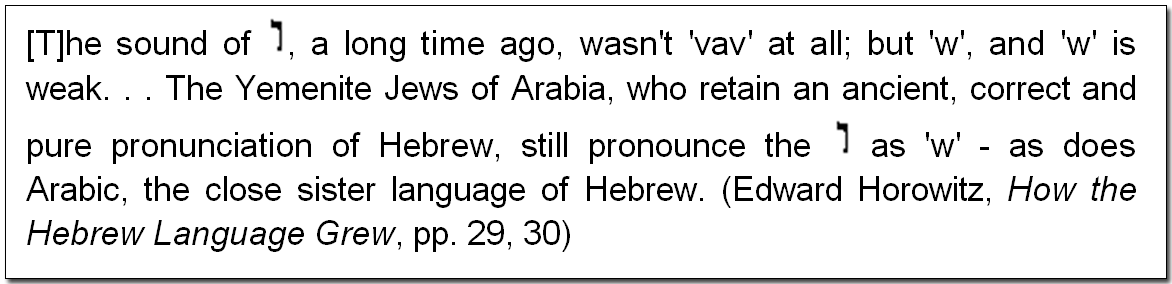
Today,
there are two primary pronunciations for Hebrew:
- Ashkenazi
(German) which came from the Central and Eastern European Jews and was spread
into every country to which they emigrated. - Sephardi
(Spanish) which was used by both Spanish and Portuguese Jews as well as those
of Hebrew descent from Oriental countries.
In
German, [w] is pronounced labiodentaly, using the bottom lip against the top
teeth producing the [v] sound. Yiddish
is spoken widely by Jews today, but its influences should not be taken as an
authority on ancient Hebrew. Yiddish is
a High German language of Ashkenazi Jewish origin. Thus, the [w] sound would indeed be
pronounced as a [v] because that is the sound it has in German. In English, however, this is not the case.
The
German (Ashkenazic) influence arose within the last 1800 years, after the Jews
were dispersed in 135 A.D. As Jewish communities
gradually developed in Eastern, Central and Western Europe, German influence
eventually made its mark on the Hebrew language. (Voy Wilks, “The Sixth Letter is Waw,”
March 3, 1996.)
However,
most scholars accept Sephardi as closer to the original Hebrew.
In
all the universities and through Israel, the Sephardic pronunciation has been
adopted, since it is generally believed that this is the pronunciation nearest
to the original . . . . (Menahem
Mansoor, Biblical Hebrew, p. 33.)
Spanish
is considered one of the “Latin” languages. But even in Latin, the [v] sound did not
enter the language until the second century A.D. (See Funk & Wagnal’s Encyclopedia, 1934 ed., under V.)
Again, [v] is a
relatively recent new-comer to Biblical Hebrew and certainly was not used in
the time of David or Moses.
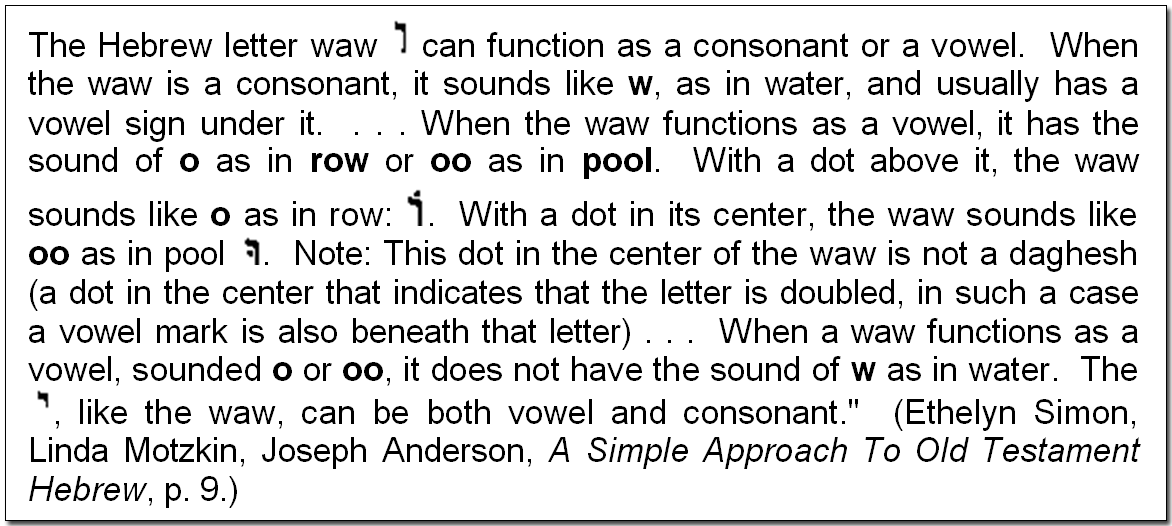
Yahuwah
gave to all nations their own languages when He confounded speech at the Tower
of Babel. Languages change over time and
this is a common occurrence. However,
Yahuwah certainly was not influenced by Ashkenazi/German speech when He spoke
His name to Moses!
“Not only did
the Jews change the waw (W) to vav (V), but in recent times have also changed the
Hebrew B to V as well. Therefore, Abraham becomes Avraham, and
Yacob becomes Yacov, Tel Abib becomes Tel Aviv, and everyone gets confused. Did
we really need two v’s in Modern Hebrew?”
(B. Earl Allen, Publish the Name
of Yahuwah, p. 35.)
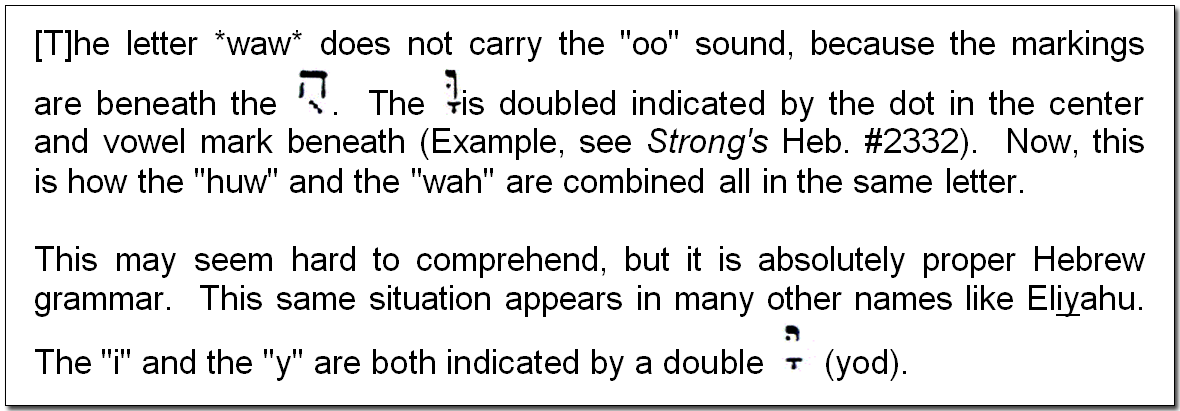
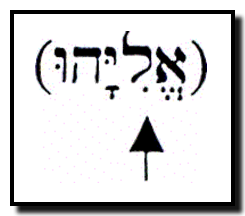

Comments