



Question: Why does WLC use
YAHUWAH for the sacred name rather than the more widely accepted YAHWEH? YaHWeH has all of the consonants that are
found in the tetragrammaton (YHWH) with only two added vowels for easy flow. It seems unnecessary to me to add a third
syllable to the holy name when the tetragrammaton was simply YHWH. Would not a two-syllable YAHWEH would be
closer to the original than the longer YAHUWAH?
Answer: Vowels
are used as needed for meaning, not
for the easy flow of sound. When considering
the sacred name of the Creator, it is important to take into account more than
just how many letters make up the tetragrammaton of the name. Many people do refer to the Father as Yahweh or Yahveh, but this is a more recent version that is inconsistent with
other evidence.
Before
the discovery of ancient manuscripts revealed that ancient Hebrew did not have
a [J], the closest translators could get to the holy name was JEHOVAH. Thus it is translated in the King James
Version:
That
men may know that thou, whose name alone is JEHOVAH, art the most high over all
the earth. (Psalm 83:18)
Behold,
God [Elohim] is my salvation; I will trust, and not be afraid: for the LORD JEHOVAH is my strength and my song; he also
is become my salvation. (Isaiah 12:2)
Trust
ye in the LORD
forever: for in the LORD
JEHOVAH is everlasting strength. (Isaiah
26:4)
It
is abundantly clear that the translators struggled to know what to do with the
texts found in Isaiah. Neither
“God” nor “LORD”
is the name of the Creator, but in both texts there appeared a contraction of
the name Yahuwah as well as the name itself.
The translators chose to distinguish the two as LORD (#3050) and JEHOVAH (#3068). In the original Hebrew, the phrase would have
been Yah YAHUWAH.
The
word Jehovah, which was as close as
they knew to get to Yahuwah, is a
three-syllable word. Yahweh/Yahveh is a
two-syllable word. There is no way to
make the sacred name (#3068) into a two-syllable word without losing some of
the meaning.
The
holy name means, literally, I AM THAT I AM.
This is a name that is composed of a repeated
state-of-being-verb: I AM. The name
Yahweh/Yahveh simply means I AM I AM.
The word “THAT” is a restrictive modifier. It specifies which I AM. Frankly, the
divine name breaks all the rules of English grammar. Suffice it to say, anyone can use the phrase
“I am.” In fact, it is used
all the time:
- “I
am cold/hungry/tired/happy.” - “I
am going to town today.” - “I
am his son.” - “I
am her mother.”
The
Almighty Creator has chosen a state-of-being verb as the only name which truly
encapsulates Who and What He is.
YAHUWAH, the three-syllable word, spells out I AM THAT I AM.
In
order to get the relative pronoun “THAT” (used as a restrictive
modifier) to specify which I AM, it
is necessary to have the word huw
(#1931, Strong’s) in there. This makes the holy name a three syllable
word, not a two-syllable word.
Further
evidence that the divine name consisted of three syllables, rather than two, is
found in the Greek attempt to transliterate the name. The Old Testament Scriptures were translated
into Greek well before the Saviour was born.
At that time, an attempt was made to transliterate YAHUWAH into
Greek. One immediate problem the
translators faced was that ancient Greek did not contain a [Y]. It was necessary to substitute Greek letters
that had as close a sound to [Y] as they could get.
Josephus,
a Jew contemporary with Yahushua, wrote histories of the Israelites for a Greek
audience. In Jewish Wars, 5. 5. 7, he wrote that the holy name was made up of
“four vowels.” Because his
intended audience spoke Greek, ‘Josephus frequently altered Hebrew names,
spelling them after the fashion of the Greeks, “to please [his Greek]
readers’ (Antiquities, 1. 5. 1.)” (B. Earl Allen, Publish the Name of Yahuwah, p. 20.)
It
is reasonable to assume that Josephus’ changing of Hebrew names was more than a
sycophantic attempt to please his audience.
Rather, it was an attempt to write the names using Greek letters, when
often those names contained sounds that did not exist in Greek. This is still done between languages.
For
example, Spanish (a Latin language) contains a letter and sound that does not
exist in English (a Germanic language).
The letter ñ does not exist in English.
However, by combining the letters [ainya]
a close approximation of the sound
can be achieved.
An
extreme example of this is the African language of Xhosa. There are absolutely no letters at all in English by which one can indicate the
particular loud “clicking” sound that is heard repeatedly in
Xhosa. Lacking anything else to do,
English sticks in an [X] to indicate the sound.
However, in English [X] does not make a clicking sound. It makes a
[Z] sound or a [KSSS] sound.
However,
even though Greek did not have a [Y] sound, the Greek attempt to transliterate
the name still had three-syllables. If
the divine name had only two-syllables in Hebrew, the Greek transliteration
would have had two syllables as well.
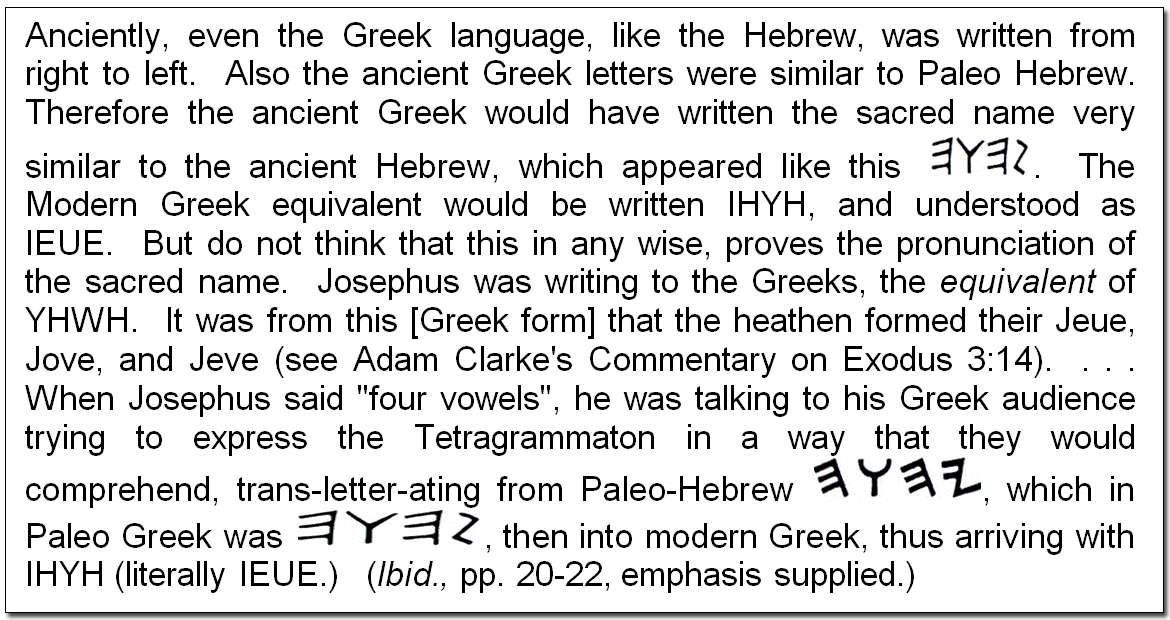
Try
to pronounce IEUE as the letters sound in English. You will see that even rendered that way, the
name is a three-syllable name.
The evidence
indicates that the holy, divine name consisted of three-syllables and in order
to get the complete meaning of I AM THAT I AM, the third syllable of huw is a necessary addition.

Comments